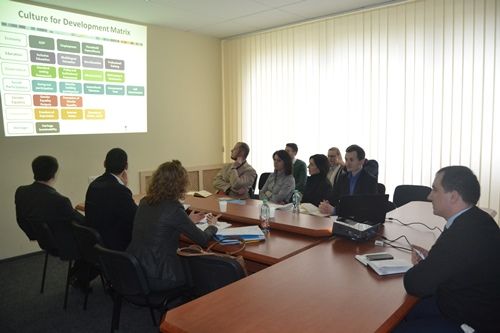

Between the 28th and the 30th of January 2015, the Ministry of Culture of the Republic of Moldova hosted a UNESCO expert mission in implementing cultural development indicators. The representative from the UNESCO Office in Venice, Matteo Rosati and Molly Steinlage, UNESCO expert in the implementation of projects on cultural indicators for development, presented the UNESCO (CDIS) "Cultural Development Indicators" project implementation methodology and how the project can help to increase public awareness regarding culture as a catalyst for development. The training sessions were attended by specialists from the Ministry of Culture, Ministry of Economy, Ministry of Labor, Social Protection and Family, Ministry of Education and the National Bureau of Statistics. The project proposes an innovative methodology that, by using empirical data demonstrates the role of culture as an engine for sustainable development processes.
Developed by UNESCO, with the support of the Government of Spain, these Indicators represent both a research and an advocacy initiative.To assess the multidimensional role of culture in development, the CDIS project addresses culture not only as a sector of activity but also in terms of values and norms that orient human action. Thus, this innovative tool encourages an inclusive vision of culture’s interactions with development, extended beyond economic benefits to explore other benefits such as social cohesion, tolerance and inclusion. To this end, the CDIS methodology examines seven key policy dimensions: Economy, Education, Governance, Social Participation, Gender Equality, Communication and Heritage.
UNESCO (CDIS) "Cultural Indicators for Development" project implementation in our country will be coordinated by the Ministry of Culture and the statistical data analysis will be carried out by a national team that includes employees of several public authorities and members of civil society.